
I don't even know where to begin with this. There so much to cover and yet i feel my blood pressure rising just thinking about some of Bauerlein's comments. I especially like the one comparing a figure who stands up and challenges youth, like Jaime Escalante (portrayed by Edward James Olmos in the movie Stand and Deliver), to fictional characters like the principle in Ferris Beuler's Day Off. Huh? Tell me how that is even a comparison?
Overall, from what i can tell, his argument is that the youth of today (not the band) can't pick out Iraq or Israel on a map, their knowledge of history and civics, and they spend way too much time watching TV? Is that it? I know, I know...i'm sure there is more to it, but as i was reading the article, I couldn't help but thinking 'people don't know this stuff because it's not meaningful to them'. Where have i heard that before?
But I'd like to focus on a small portion of his argument that deals with the arts. So, apparently 1 in 10 have attended a jazz concert. I buy that. Whens the last time you went to a jazz concert? It's been at least 5 years for me, and i really don't consider Bela Fleck and the Flecktones to be purely jazz. Jazz shows are stuffy in my opinion, while i love to listen to it, i find myself trying to figure out what the musicians are doing rather than just listening and enjoying. I think Frank Zappa said it best when he said "Jazz isn't dead, it just smells funny". That's about the best way i can describe a jazz show.
But, when is the last time you went to a rock and roll show at a local club, bar, or all ages venue? Now, let me just say, i'm very biased when it comes to this. I've been attending DIY shows and playing in bands since 1991. But how is this any different than attending a jazz concert? Are the musicians no good? I'd beg to differ. I realize that they are two different genres, but to consider one form of music to be superior than another is ludicrous. But to me, here is the biggest difference between a DIY show or a jazz show: DIY shows are, more than not, put together by kids for kids. They are all ages. They get kids involved in everything from 'zine making, bands, promotion, photography, and political and social activism (e.g. vegatarianism/veganism, civil rights, anti-drinking and drug campaigns, etc). It all grows from this larger community of people--a community of practice. I can say this: Had i not been exposed to this community, i can't even imagine where my life would be at this point. It's a pretty good bet that i would not be attending a graduate program and getting a Ph.D.
So, Mr. Bauerlein...maybe you should ask: What's the last concert or DIY show you attended? I bet you get a better ratio than 1 in 10.
Classical music is no better. 1 in 12. But come on now, how many times can you hear Beethoven and Mozart? How about some modern composers works? Now, i know my argument doesn't hold much water here in Bloomington, but, i'm doubting the stats Mr. Bauerlein presents are from areas that have one of the, if not the, top rated music schools in the world. My argument is the same as the jazz one.
Ballet? No? How about going to a dance club? Or watch "So You Think You Can Dance". Does that count? How is it different?
1 in 4 go to a museum. I'd say thats pretty good actually. Do you know how expensive it is to go to a museum?
1 in 40 play a classical musical instrument? Why does it have to be a classical instrument? Because the guitar has evolved into the electric realm automatically discredits it's importance? I would disagree. Restate the question and take out the 'classical' wording.
So the numbers in attendance of performing arts have dropped. How about the number of those performing, writing, directing, and/or animating their creations and putting them on Youtube?
Mr. Bauerlein, your arguments are soft and hint at cultural superiority on your part.
Sunday, December 6, 2009

Monday, November 23, 2009
What is Art? Or, how Dewey makes my head hurt.
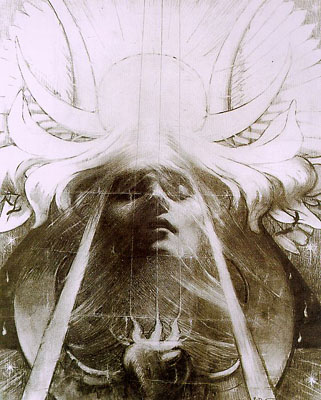
Jean Delville is the greatest artist ever

Discuss.
"Watermelons in Easter Hay" (by Frank Zappa) is one of the most thoughtful expressions on guitar ever played...go listen. I'll wait.
Discuss.
"The Godfather" and "The Godfather II" are cinematic masterpieces.
Discuss.
I could keep going, but you get the picture. Now, had you really discussed it, i'm sure you may argue one way or the other that I'm full of it. But is it art? What is art? With regards to the first 2 I mentioned, we'll never know, they're both dead. Although, Zappa has been quoted many times that he writes music for his own enjoyment and that he likes to hear the 'absurdity' of his ideas and that if someone enjoys it, so be it. So thats art?
So how do we come to enjoy the arts (i say the arts, cause you know me, i have to include music)? It all starts with a new way to teach; develope a new language that incorporates visual, digital, anthropological arts (thank your Freedman and Sturh). While it seems obvious, we don't really know what is being learned when we engage in arts activities (thank you Hetland et. al.). The answer? Constructionism! (Kylie is going to be so proud of me).
A simple, yet ingenious 3 tiered approach:
1-Engagement,
2-Personal connection to work,
3-Value of projects to larger community
Discuss.
"Watermelons in Easter Hay" (by Frank Zappa) is one of the most thoughtful expressions on guitar ever played...go listen. I'll wait.
Discuss.
"The Godfather" and "The Godfather II" are cinematic masterpieces.
Discuss.
I could keep going, but you get the picture. Now, had you really discussed it, i'm sure you may argue one way or the other that I'm full of it. But is it art? What is art? With regards to the first 2 I mentioned, we'll never know, they're both dead. Although, Zappa has been quoted many times that he writes music for his own enjoyment and that he likes to hear the 'absurdity' of his ideas and that if someone enjoys it, so be it. So thats art?
So how do we come to enjoy the arts (i say the arts, cause you know me, i have to include music)? It all starts with a new way to teach; develope a new language that incorporates visual, digital, anthropological arts (thank your Freedman and Sturh). While it seems obvious, we don't really know what is being learned when we engage in arts activities (thank you Hetland et. al.). The answer? Constructionism! (Kylie is going to be so proud of me).
A simple, yet ingenious 3 tiered approach:
1-Engagement,
2-Personal connection to work,
3-Value of projects to larger community
Monday, November 9, 2009
It's all fluency, flexibility, and mud.
I can't believe i haven't blogged in so long. I have a post waiting to be posted on my progress with Impromptu, but as life happens, i got the flu. Now, i'm not saying it's H1N1, but the flu nonetheless. Needless to say, i was out of commission for some time. But now, i'm back (oh joy!).
Regarding the readings for this week, i was happy to see the notion of fluency mentioned. In an earlier post I argued:
It seems that literacy has been talked about like it's some sort linear thing that has a start and end point. It's not, it's evolving. And what happens if you are an expert in an area? Is literacy over? You're totally literate with nowhere to go? I don't think so. But now we're getting into creativity/innovation, aren't we? That's a whole other discussion.
Now, before i start going all "Nelson" on traditional literacy (e.g. HA-HA), let me re-trace my steps on why see it this way. I'll do this by constructing my concept map.
First, i read the diSessa paper in which I sum up as this (just click on the picture):
I stepped back and looked at this and thought...kinda circular. Next i read Reas article and got, yet another view of literacy and that was saying people gaining skills to develop software and tools that help them communicate their ideas. Huh? I wasn't sure what to make of that, but put it on the map (you'll see the full map later.
Next, i read the Resnick piece. Can you say mud? Such a great metaphor for how technology should be...like mud. This is expanded on in the Smith paper that says technology should be made for flexibility and fluency. Ahhh...ok, now i'm getting it. So, the diSessa map i made is starting to come together. That is, in order for this to happen, we need flexibility...MUD!
So what does this do for literacy? I guess that depends on who you ask. I still say that literacy is a term that is too concrete. With the technological changes literacy needs to be evolving, which is why i like the term fluency. Think about all the projects you've worked on in class...you're 'literacy', at least mine, was flexible and expanding due to the construction of a meaningful artifact. Hmmm...interesting.
Then comes creativity...such a fun topic that i know little about, but i know it when i see it. Instead of trying to explain my thought process, i'll just show it. It's hard to read...so just click on it.

Regarding the readings for this week, i was happy to see the notion of fluency mentioned. In an earlier post I argued:
It seems that literacy has been talked about like it's some sort linear thing that has a start and end point. It's not, it's evolving. And what happens if you are an expert in an area? Is literacy over? You're totally literate with nowhere to go? I don't think so. But now we're getting into creativity/innovation, aren't we? That's a whole other discussion.
Now, before i start going all "Nelson" on traditional literacy (e.g. HA-HA), let me re-trace my steps on why see it this way. I'll do this by constructing my concept map.
First, i read the diSessa paper in which I sum up as this (just click on the picture):

I stepped back and looked at this and thought...kinda circular. Next i read Reas article and got, yet another view of literacy and that was saying people gaining skills to develop software and tools that help them communicate their ideas. Huh? I wasn't sure what to make of that, but put it on the map (you'll see the full map later.
Next, i read the Resnick piece. Can you say mud? Such a great metaphor for how technology should be...like mud. This is expanded on in the Smith paper that says technology should be made for flexibility and fluency. Ahhh...ok, now i'm getting it. So, the diSessa map i made is starting to come together. That is, in order for this to happen, we need flexibility...MUD!
So what does this do for literacy? I guess that depends on who you ask. I still say that literacy is a term that is too concrete. With the technological changes literacy needs to be evolving, which is why i like the term fluency. Think about all the projects you've worked on in class...you're 'literacy', at least mine, was flexible and expanding due to the construction of a meaningful artifact. Hmmm...interesting.
Then comes creativity...such a fun topic that i know little about, but i know it when i see it. Instead of trying to explain my thought process, i'll just show it. It's hard to read...so just click on it.

Saturday, October 10, 2009
Part 2.5 or "Am I literate?"
So the project below you heard in Pt.2 (if you haven't, take a few minutes to do so) is me. One day i just got a new MIDI keyboard controller that had just a minute 2 octave range. So i decided to plug it in and noodle away. Now, what you didn't hear was the full 16+ minute of me just constructing the piece. So, out of 16+ minutes, you only hear 4. So technology strikes again.
But lets be honest, do you really think that even in those 4 minutes that i meant to hit all those notes? As much as i would like to say that i did, i didn't. So, luckily, i went in and could move notes where i wanted (pitch) and extend or shorten them (duration) depending on my likeness. Strike another one up for technology.
I finally added some compression to even out the sound over the entire piece as well as some reverb to add some depth. Again...technology. Gotta love it.
So? Lets think about 20 years ago (wow, i'm dating myself). But had i done this on conventional tape, what you may hear would be choppy, more wrong notes than right one's, and actually, you wouldn't have heard anything, cause i wouldn't have been able to post on the internet (yay technology!)
Am I literate?
That depends. Literate in what? Religious text...well, 12 years of catholic school...guess that makes me literate. Wow, am i glad that's NOT the way it is. So, what else is there? I can write and read and for the most part I understand what I write and read. Literate? Not really.
I always equated literacy as some sort of synonym for expertise or competency in an area. I still think thats the case. The area (whatever it is--blogging, music, reading, etc.) has some norms associated with it. We develope in a literacy by how you (or I) make sense, create, and critique/reflect in the area.
It seems that literacy has been talked about like it's some sort linear thing that has a start and end point. It's not, it's evolving. And what happens if you are an expert in an area? Is literacy over? You're totally literate with nowhere to go? I don't think so. But now we're getting into creativity/innovation, aren't we? That's a whole other discussion.
In conclusion, my head hurts (bordering on a migrain), my son has a fever (c'mon H1N1), and that Kress article may just be the reason for my headache. But literacy is not linear, nor is it just related to reading and writing. To me, being literate is being aware of the different Discourses (notice the big "D") in which you operate. I know that doesn't really explain it, but maybe my concept map will?
A note on the concept map I made
In case anyone is interested, there is software out there in which you can make a concept map pretty easily. I've been messing with it since yesterday and i'm really starting to like it. It really does bring to light some things that you may overlook. The software is from Smart and you can get it here. You can try it out for 30 days before buying it.
But lets be honest, do you really think that even in those 4 minutes that i meant to hit all those notes? As much as i would like to say that i did, i didn't. So, luckily, i went in and could move notes where i wanted (pitch) and extend or shorten them (duration) depending on my likeness. Strike another one up for technology.
I finally added some compression to even out the sound over the entire piece as well as some reverb to add some depth. Again...technology. Gotta love it.
So? Lets think about 20 years ago (wow, i'm dating myself). But had i done this on conventional tape, what you may hear would be choppy, more wrong notes than right one's, and actually, you wouldn't have heard anything, cause i wouldn't have been able to post on the internet (yay technology!)
Am I literate?
That depends. Literate in what? Religious text...well, 12 years of catholic school...guess that makes me literate. Wow, am i glad that's NOT the way it is. So, what else is there? I can write and read and for the most part I understand what I write and read. Literate? Not really.
I always equated literacy as some sort of synonym for expertise or competency in an area. I still think thats the case. The area (whatever it is--blogging, music, reading, etc.) has some norms associated with it. We develope in a literacy by how you (or I) make sense, create, and critique/reflect in the area.
It seems that literacy has been talked about like it's some sort linear thing that has a start and end point. It's not, it's evolving. And what happens if you are an expert in an area? Is literacy over? You're totally literate with nowhere to go? I don't think so. But now we're getting into creativity/innovation, aren't we? That's a whole other discussion.
In conclusion, my head hurts (bordering on a migrain), my son has a fever (c'mon H1N1), and that Kress article may just be the reason for my headache. But literacy is not linear, nor is it just related to reading and writing. To me, being literate is being aware of the different Discourses (notice the big "D") in which you operate. I know that doesn't really explain it, but maybe my concept map will?
A note on the concept map I made
In case anyone is interested, there is software out there in which you can make a concept map pretty easily. I've been messing with it since yesterday and i'm really starting to like it. It really does bring to light some things that you may overlook. The software is from Smart and you can get it here. You can try it out for 30 days before buying it.
Tuesday, October 6, 2009
Whats "new" in music new media Pt 2.
Listen (and watch if you want). Maybe, if you're lucky, I'll explain the 'new' media aspects.
Sunday, October 4, 2009
Whats "new" about new media?
Before i even start, i must say that I am looking at this from a music learning standpoint, not just an overall new media standpoint. My reasons are simple: Thats what i'm interested in.

So what is "new" mean in new media in music learning? Well, I actually thought about this before class last week and was going to blog about it, but, as we know, life happens and i never got around to it. But Dr. Dodge brought up an interesting point in his talk. Do any of you audiophiles out there remember "reel to reel" tapes?
Well, I remember them, quite vividly. I was in a trade school for audio engineering (you know...record bands, film scores, sound design). Anyway, we spent weeks on learni ng how to cut and splice tape together. And not just little 1/4" tape (e.g. cassette size), but i'm talking the mammoth 2" stuff. Ahhh, those were the days. So I cut many a finger learning how to do this and once the unit was complete, they take us into a room and show us this (see above screen shot)
Yep...a Macintosh computer with a program called Sound Designer. They said, "you'll never have to edit tape again". And they were right.
Was I ticked off? Yeah! Was it beneficial to learn the right way? Yep! You see, since i learned how to do it the 'old-school' way, whenever i used a computer to edit audio, i always use my ears and not just my eyes. I make sure my edits sound clean. I've heard many recordings (bands, commercials, etc.) where I can hear the edits and it bugs me.
So what happened here? An appropriation of sorts i guess. The old merged with the new. The concept is the same, but a new aspect of the concept was added...vision. It's nothing new, really if you think about it.
Music-technology-learning
Throughout the years, music and the computer have been merging. This has allowed immediate feedback to the listener. Instead of writing music notes on a piece of paper, getting that music broke down into parts, hiring musicians, and finally getting to hear your creation (which could take months, even years), we now can hear it instantly. But here is the issue: What if you have never written music before or took a theory class or played an instrument?
What i'm about to type is NOT a condemnation of music classes or how music educators choose to teach music. I'm sure we can all agree that music is one of the lower subjects on the schools hierarchy of classes. However, the way music is taught in school is not beneficial to the students. In my view, it's archaic in some ways. It's also confusing as well.

Jeanne Bamberger, who's work on intution, states that musically untrained people (kids and adults) already know alot about music and the way we teach them is confusing. We are not allowing them to build and reflect on their intuitive knowledge. We are trying to replace what they already know with language and concepts that don't fit. Makes sense to me...but then again, i'm biased.
So what to do? Again, i think Bamberger says it best in her article "The Development of Intuative Musical Understanding: A Natural Experiment" (2003, p. 34):
If a general pedagogical approach emerges from this study, it rests on the finding that the basic characteristics of tonal structure are already part of musically untrained students’ intuitive knowledge-in-action. Thus, a curriculum for elementary music fundamentals classes should recognize, build on and help students develop these intuitions in at least the following ways: ● first, give students ‘units of work’ that are consistent with their intuitive ‘units of perception’ – aggregated, structurally meaningful entities such as motives, figures and phrases; ● second, provide a working environment such that materials are easily manipulated at mutiple levels of structure – for instance, at the aggregate motive level, and also easily modified at the more detailed level of their pitch and duration ‘contents’; ● third, encourage compositional, action-based projects that necessarily direct students’ attention to context and within contexts to structural functions; ● fourth, give students easy access to a variety of representations that include: multiple sensory modalities, multiple graphics and multiple levels of musical structure; ● fifth, encourage students to invoke strategies that will help make their intuitive knowledge explicit, e.g. listening critically, designing, improvising/ experimenting and reflecting on decision-making criteria, along with trying to account for results.
But what about the music? Shouldn't kids learn how to read music and play an instrument? I say yes, to a certain point. I'm self-taught, so most of my musical knowledge is from playing around...tinkering i suppose. Yes, i've had theory classes, and to be honest, i hated them. It actually made me not want to write music on a computer. And i loved doing that...just putting the little black notes on the sheet in weird combination and hearing the result. But no!! Theory classes took all the fun out of that (i.e. "you can't have parallel fifths, you can't skip that many steps between notes"). But now we're just getting into aesthetics...pure subjectivity. What i find pleasing to my ear, you won't. But my biggest regret is not taking theory early in life. I thought of theory as a set of rules to govern song writing, which i was very rebellious against (thank you Mr. Zappa), but it's not, it's just a theory, a set of practices. And what has to be done is merge those practices with new practices. Music has a language all it's own...and until recently, only a few could speak and write in that language. Now, with the appropriation of technologies, that language is taking on new meanings. Meanings being made up by 'musically untrained' individuals (whatever that means). So, review what Jeanne Bamberger said above and you tell me...make sense?
So what is "new" mean in new media in music learning? Well, I actually thought about this before class last week and was going to blog about it, but, as we know, life happens and i never got around to it. But Dr. Dodge brought up an interesting point in his talk. Do any of you audiophiles out there remember "reel to reel" tapes?
Well, I remember them, quite vividly. I was in a trade school for audio engineering (you know...record bands, film scores, sound design). Anyway, we spent weeks on learni
ng how to cut and splice tape together. And not just little 1/4" tape (e.g. cassette size), but i'm talking the mammoth 2" stuff. Ahhh, those were the days. So I cut many a finger learning how to do this and once the unit was complete, they take us into a room and show us this (see above screen shot)Yep...a Macintosh computer with a program called Sound Designer. They said, "you'll never have to edit tape again". And they were right.
Was I ticked off? Yeah! Was it beneficial to learn the right way? Yep! You see, since i learned how to do it the 'old-school' way, whenever i used a computer to edit audio, i always use my ears and not just my eyes. I make sure my edits sound clean. I've heard many recordings (bands, commercials, etc.) where I can hear the edits and it bugs me.
So what happened here? An appropriation of sorts i guess. The old merged with the new. The concept is the same, but a new aspect of the concept was added...vision. It's nothing new, really if you think about it.
Music-technology-learning
Throughout the years, music and the computer have been merging. This has allowed immediate feedback to the listener. Instead of writing music notes on a piece of paper, getting that music broke down into parts, hiring musicians, and finally getting to hear your creation (which could take months, even years), we now can hear it instantly. But here is the issue: What if you have never written music before or took a theory class or played an instrument?
What i'm about to type is NOT a condemnation of music classes or how music educators choose to teach music. I'm sure we can all agree that music is one of the lower subjects on the schools hierarchy of classes. However, the way music is taught in school is not beneficial to the students. In my view, it's archaic in some ways. It's also confusing as well.

Jeanne Bamberger,
 who's work on intution, states that musically untrained people (kids and adults) already know alot about music and the way we teach them is confusing. We are not allowing them to build and reflect on their intuitive knowledge. We are trying to replace what they already know with language and concepts that don't fit. Makes sense to me...but then again, i'm biased.
So what to do? Again, i think Bamberger says it best in her article "The Development of Intuative Musical Understanding: A Natural Experiment" (2003, p. 34):
If a general pedagogical approach emerges from this study, it rests on the finding that the basic characteristics of tonal structure are already part of musically untrained students’ intuitive knowledge-in-action. Thus, a curriculum for elementary music fundamentals classes should recognize, build on and help students develop these intuitions in at least the following ways: ● first, give students ‘units of work’ that are consistent with their intuitive ‘units of perception’ – aggregated, structurally meaningful entities such as motives, figures and phrases; ● second, provide a working environment such that materials are easily manipulated at mutiple levels of structure – for instance, at the aggregate motive level, and also easily modified at the more detailed level of their pitch and duration ‘contents’; ● third, encourage compositional, action-based projects that necessarily direct students’ attention to context and within contexts to structural functions; ● fourth, give students easy access to a variety of representations that include: multiple sensory modalities, multiple graphics and multiple levels of musical structure; ● fifth, encourage students to invoke strategies that will help make their intuitive knowledge explicit, e.g. listening critically, designing, improvising/ experimenting and reflecting on decision-making criteria, along with trying to account for results.
But what about the music? Shouldn't kids learn how to read music and play an instrument? I say yes, to a certain point. I'm self-taught, so most of my musical knowledge is from playing around...tinkering i suppose. Yes, i've had theory classes, and to be honest, i hated them. It actually made me not want to write music on a computer. And i loved doing that...just putting the little black notes on the sheet in weird combination and hearing the result. But no!! Theory classes took all the fun out of that (i.e. "you can't have parallel fifths, you can't skip that many steps between notes"). But now we're just getting into aesthetics...pure subjectivity. What i find pleasing to my ear, you won't. But my biggest regret is not taking theory early in life. I thought of theory as a set of rules to govern song writing, which i was very rebellious against (thank you Mr. Zappa), but it's not, it's just a theory, a set of practices. And what has to be done is merge those practices with new practices. Music has a language all it's own...and until recently, only a few could speak and write in that language. Now, with the appropriation of technologies, that language is taking on new meanings. Meanings being made up by 'musically untrained' individuals (whatever that means). So, review what Jeanne Bamberger said above and you tell me...make sense?
Monday, September 21, 2009
Fun with chord progressions
So at last I have something on Scratch that actually works. I came up with the idea after surfing the web for online music tools that seem to be pretty popular in some music classrooms. After looking at some of them, i thought, "hey, i should be able to make something in Scratch!"
So here is what I have so far. Right now it's a movie taken from my computer, so you'll have to watch it. Basically i'm typing the corresponding numbers under each piano picture. Each number is in reference to the chord progression in the key of C Major (e.g. 1 = C, E, G, 2 = D, F, A, and so on).
My initial plan was to have it play chords (e.g. all at the same time) instead of arpeggios (e.g. separate). But I didn't find a way to do that, so I adjusted a bit. But actually, what I found, is that you can come up with pretty interesting layers as you type away.
The most interesting thing I took away from doing this is that i was in the Flow. For those of you unsure of what i'm talking about, Flow is basically loosing track of time cause your so engrossed in what your doing--the challenges of the task are neither to hard or to easy to accomplish. Plus, this was meaningful to me in ways that reflect my interest in learning and in music.
I can just hear it now...a Scratch Symphony. No, seriously, think about it my P650 friends. Each of you assigned a number/numbers on your keyboard, and when I (the conductor of course) point to you, you type that particular number.
So here is what I have so far. Right now it's a movie taken from my computer, so you'll have to watch it. Basically i'm typing the corresponding numbers under each piano picture. Each number is in reference to the chord progression in the key of C Major (e.g. 1 = C, E, G, 2 = D, F, A, and so on).
My initial plan was to have it play chords (e.g. all at the same time) instead of arpeggios (e.g. separate). But I didn't find a way to do that, so I adjusted a bit. But actually, what I found, is that you can come up with pretty interesting layers as you type away.
The most interesting thing I took away from doing this is that i was in the Flow. For those of you unsure of what i'm talking about, Flow is basically loosing track of time cause your so engrossed in what your doing--the challenges of the task are neither to hard or to easy to accomplish. Plus, this was meaningful to me in ways that reflect my interest in learning and in music.
I can just hear it now...a Scratch Symphony. No, seriously, think about it my P650 friends. Each of you assigned a number/numbers on your keyboard, and when I (the conductor of course) point to you, you type that particular number.
Subscribe to:
Posts (Atom)

